Saturday, March 2, 2013

Inspired toolmaking - Hammer

 After watching the previous inspiring videos, I decided to finish up some older tool projects and maybe start some new ones.
The following is a rather old project, which I had never finished, namely a Japanese style, weight-forward forging hammer. Is is basically a piece of AISI 1060 steel, with a round hole machined at one end, and then heat-treated to about 50 HRc, the same hardness as my anvil, or maybe slightly softer.


 Of course after finishing it, I realized how simple, clunky (though it still does its job well) and inelegant it truly is. Hmmm, better design next time. For now here are some samples of proper Japanese style forging hammers, found at:

http://www.mehr-als-werkzeug.de

thejapanwoodworker.com

and http://owenbush.co.uk/tools

Friday, March 1, 2013

Inspired toolmaking!

Just came across this video (which is actually the first in a set of three) about a small group of Latvian
craftmen, Neeman Tools, building hand made tools, like knives, axes and chisels.
The videos are excellent, and their site has been overwhelmed with orders... which is perfectly logical
as they exhume the true spirit and joy of good craftsmanship. Enjoy!


Just to be fair, it came to my attention that John Neeman, the bladesmith after whom the previous site
is named, went out and established his own firm, Autine, which has come out with another video. Equally impressive, though I feel the speak-over is unneeded...


http://www.johnneeman.com/media/slider/705c44b34bfa00547d56adac5cba27de.jpg

Sunday, February 17, 2013

Athame WIP

A friend ordered a ceremonial Athame, which I have started forming out of an old handmade rasp I found. Seems to be coming out nicely, with a triangular shaped cross section, much like a Japanese yari.
I will go for an olive oil quench (instead of water) both because it's a mystery steel, and  to avoid breaking the blade, as such double edged blades are prone to. Then temper, polish and retemper-heat color to a purplish black, as that is the color an Athame is supposed to have.


I am currently struggling with the shape of the hilt (again fashioned from a piece of Iroko hardwood I found somewhere), trying to give it some organic shape, inspired by master knife maker Gerhard Wieland. By the way if you want to take a look at his incredible work try http://www.wieland-der-schmied.de/03_1_messer.html.


Monday, October 22, 2012

Eye candy - palladium-silver mokume wedding rings

 OK, just received some professional photos from the wedding, showing the previously posted palladium-silver mokume gane wedding rings in a light and setting they deserve. The wedding crowns were also hand-made out of shibuichi and silver wire; simple yet elegant. Enjoy!


By the way, I am building a commercial site, where items such as these will be up for order and sale. Stay posted...


Sunday, October 14, 2012

Increased Blog traffic

I have been keeping this blog for about 2 years now, and suddenly there has been a 4 fold increase in
views. At first I was suspicious, people just tell me to be grateful.

Please do not hesitate to leave comments, and tell me what you like, don't like, and what you'd like to see more of...

Black metal

It has been really hot over here to light the forge, hence the long pause in posts.
I have also been away on other business, but rest assured that I am preparing something major,
which will be announced shortly.

For the time being here are a couple of thoughts on a fascinating subject, Black Metal.
It seems that developing a metal with a black color that will not corrode, rust or discolor has been a
self imposed task of metallurgists since Antiquity.

Indeed, the Egyptians, Myceneans, Greeks and Romans had developed a series of mysterious alloys, Corinthian or Black Bronze or Aes, Hepatizon (from the greek word Hepar 'liver' indicating its color), and others.

Pliny gives us a few hints, but the credibility of his account is questionable, as the composition of such valuable alloys must have been a well guarded guild secret.


Nowadays, we can get more information by analyzing extant specimens of such black colored metals on antique decorative artifacts. It seems that a variety of alloys of copper, silver and gold were utilized to achieve the color. Here are a couple of links for the more academically inclined:

Colourful Corrosion: Black Bronze and its Enigmatic Patina
http://pia-journal.co.uk/article/download/14/27

Laboratory Investigation of Inlays and Surface Treatments for the Decoration
of Copper-Base Alloy objects from the Imperial Roman Period
http://orbi.ulg.ac.be/bitstream/2268/34863/1/Article%20Archaeometry.pdf

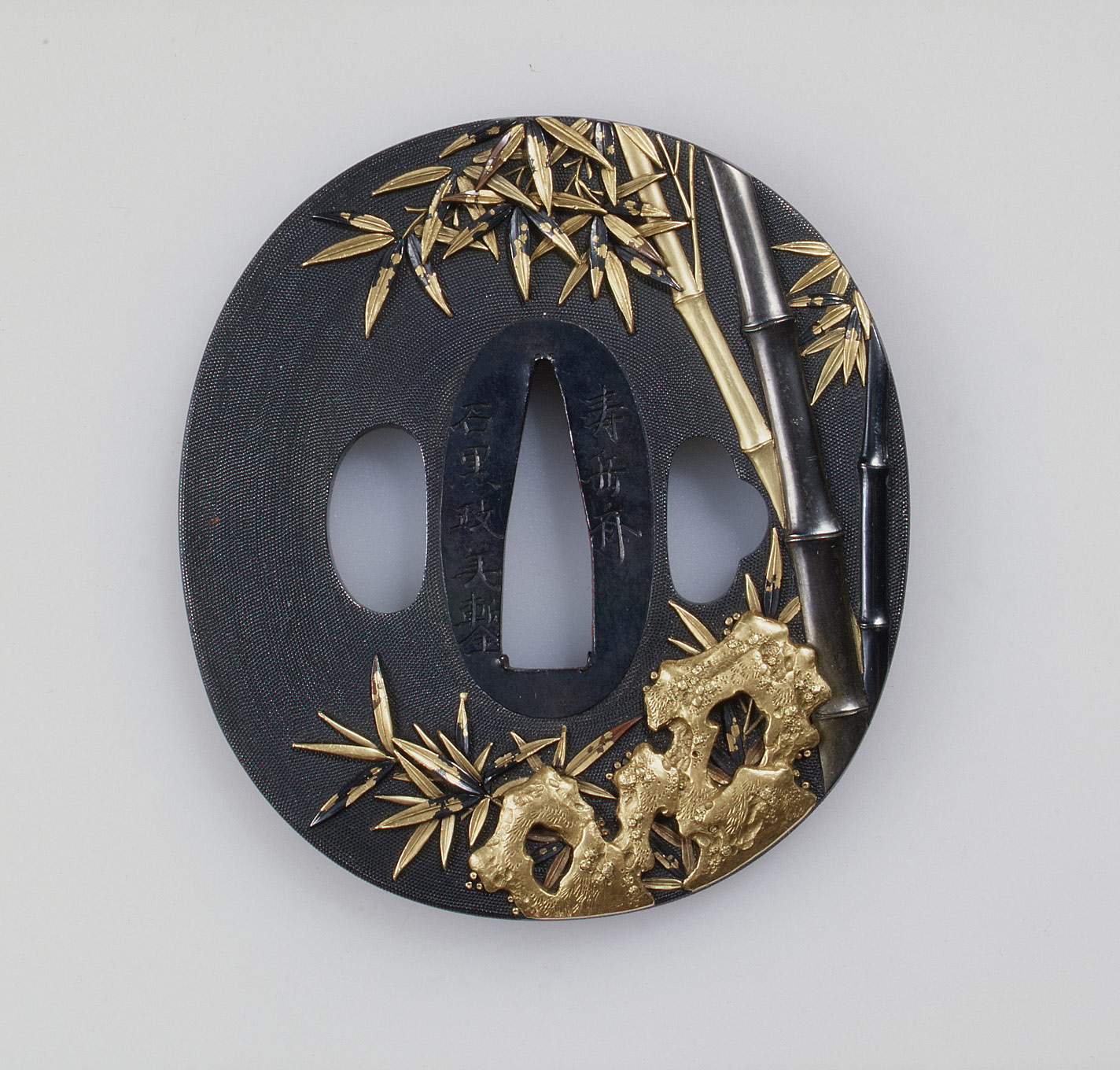
There is also another large group of alloys of greyish to black color developed in the East, and surviving in Japanese traditional metalwork, namely the irogane alloys, Shibuichi, Shakudo, Kuromido, etc. These are again copper, silver, gold and sometimes lead or arsenic alloys that patinate to a variety of blackish hues.

http://www.metmuseum.org/toah/images/h2/h2_36.120.79.jpg

Again here are a couple of papers on the subject:

Japanese irogane alloys and patination – a study of production and application
http://shura.shu.ac.uk/971/ 

Japanese Shakudo: Its History, Properties and Production from Gold-Containing Alloys
http://www.springerlink.com/content/n2006277t705624g/ 

Finally there is a newer pattented, German industrial alloy, named mujodogane which supposedly takes on a permanent or semi-permanent black color. 
http://mujodogane.erlebe-es.de/synapsecore.php?mainnode=synapsepath/Informationen_ueber_Mujodogane
The site offers little info on what the alloy contains, other than naming it a silver alloy.
Now as much as I would like to believe it, the above bibliography speaks against any silver based alloy being black, but since they do not give us the composition, I cannot dispute the claim, even though I am personally, highly sceptical.

I guess it is time for me to start experimenting, as a black alloy for mokume-gane that does not corrode or discolor would be a true delight. More on the subject in future posts.